Somebody Is Copying You Right Now
Stand on a metro platform for ten minutes and actually look at people.
Everyone is in the same jeans. Not similar. The same cut, the same weight, the same length breaking at the same point above the shoe. The men have shaved off beards they spent two years growing, because the face that reads as attractive shifted sometime last winter. A lot of them are doing jaw exercises they found on a feed. The women have the same hair, parted the same way. Everyone is holding a phone at the same angle. Elbow tucked, screen low.
Two people sit knee to knee for twenty minutes and never look up. Both scrolling. Neither reading, because the scroll is too fast to be reading. They get off at different stations and nothing passes between them. Not a word, not a glance. This is unremarkable now. This is what a train looks like.
Go into any new cafe in this city. Exposed brick. Light wood. Edison bulbs. Chalkboard menu. A plant. That exact cafe exists in Bangalore, in Nairobi, in Portland, in Cape Town. Somebody in Melbourne is sitting in it right now, drinking the same flat white under the same lightbulb.
Then there are the books.
Everyone is reading, and that should be good, because books are one of the few things left that genuinely change how a person thinks. But the same six titles circulate. Everyone has the Stoics. Everyone has the one about habits. The book gets photographed on a wooden table next to a coffee, and then it sits at page forty for four months.
The person who bought it will tell you they’re reading it. They’re not lying. Something real did happen. They wanted to become someone, and they spent money in the direction of that person. The intention was sincere.
The book is still at page forty.
Nobody decided any of this. That’s the part that gets me. There was no meeting. No one issued an instruction. And yet several million people independently arrived at the same jeans, the same jaw, the same six books, the same cafe, and every one of them experienced their share of it as a personal choice.
Either that’s a coincidence of impossible size, or something is running underneath us that we can’t see while we’re standing in it.
In 1929, a man named Edward Bernays was hired by the American Tobacco Company with a specific problem. Women were smoking indoors. They weren’t smoking on the street. Half the market sat there untouched because of a social taboo.
Bernays is generally called the father of public relations. He was also Sigmund Freud’s nephew, and he had absorbed his uncle’s conviction that people don’t act on reasons. They act on things underneath reasons, and if you understand what’s underneath, you can move them. He consulted a psychoanalyst named A.A. Brill, who told him something useful. Cigarettes carried the association of male power. Which meant they could be offered to women as something other than a cigarette.
On Easter Sunday, March 31, 1929, a group of young women walked into the Fifth Avenue parade in New York and lit Lucky Strikes in front of the cameras. They told reporters they were lighting “torches of freedom.â€
The press had been informed in advance that a protest was going to happen. The woman leading the group, Bertha Hunt, was Bernays’ own secretary, instructed to present herself as a women’s rights advocate. The next morning the New York Times covered it as a story about emancipation.
Neither Bernays nor the tobacco company was named anywhere in the coverage.
That’s the story everyone tells. Here’s the part almost nobody includes, and it’s why I went looking.
In 2015, a researcher named Vanessa Murphree went back through what the 1929 press actually printed. She found that the campaign’s legendary status, the idea that it single-handedly changed a nation’s behaviour, was itself largely a myth that Bernays promoted for decades afterward.
He manufactured the desire. Then he manufactured the story of how effectively he’d manufactured the desire. The second one worked better than the first.
The most famous story about engineered wanting is itself partly an engineered story.
But the mechanism underneath it is real, and René Girard spent forty years explaining why it works.
Girard was a French literary critic who noticed, reading novel after novel, that characters never wanted things directly. Desire always arrived through a third party. A man wanted a woman because his friend wanted her. Someone wanted a position because a rival held it. Girard stopped treating this as a device novelists used and started treating it as a description of the species.
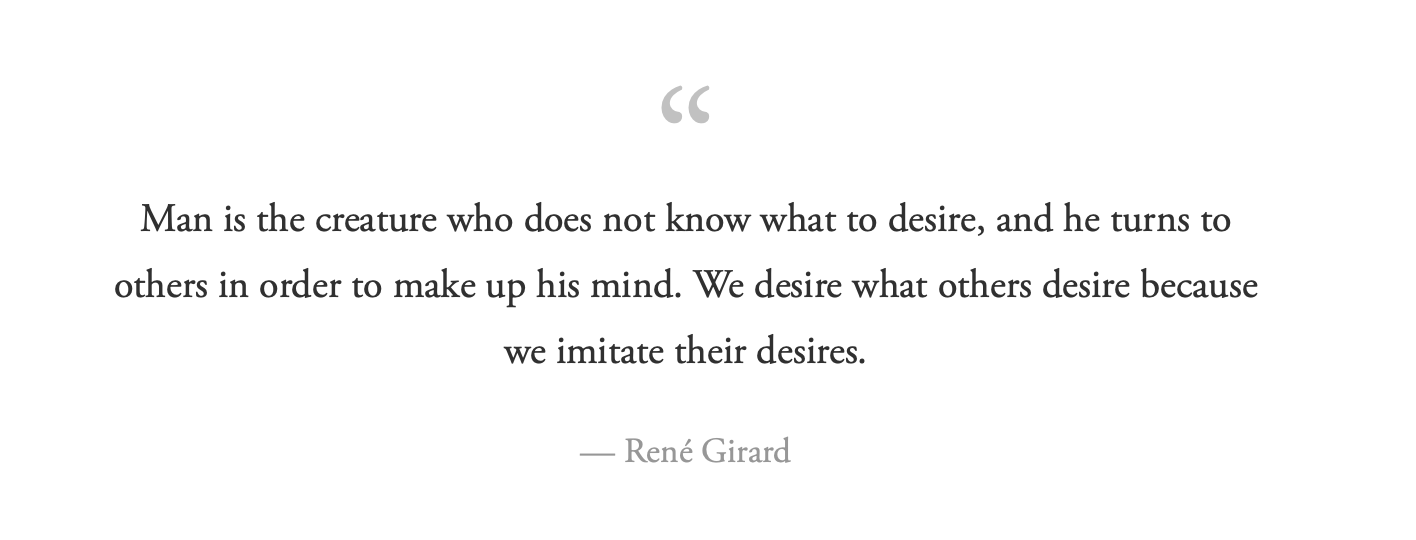
The claim is stranger than it first sounds. He isn’t saying we copy behaviour. Everyone knows we copy behaviour. He’s saying we copy the wanting itself.
We don’t generate desires and then go looking for objects. We look at other people first, register what they seem to want, and take the wanting from them. By the time it surfaces in us, it has been converted into something that feels like it came from inside.
That conversion is the entire problem. Mimetic desire is invisible from within. You cannot feel it operating. Which is why everyone on that train is certain that everybody else is following a trend while their own choices were considered.
Girard’s phrase for this is that we are opaque to ourselves and transparent to everyone else. Your models are visible to every person who knows you. They are not visible to you.
If that sounds like the kind of theory that stays in a seminar room, look at what happened when somebody took it seriously.
Peter Thiel sat in Girard’s classes at Stanford as an undergraduate in the late eighties. Years later he became the first outside investor in Facebook, half a million dollars into a college project, and he has said openly that mimetic theory was part of the reason. A platform where you watch what other people want, which spreads by people watching each other use it. Doubly mimetic, in his phrase. When Girard died in 2015, Thiel spoke at the memorial.
Girard spent his life describing mimetic desire as something dangerous. A mechanism that generates rivalry, and eventually violence, and needs to be contained.
His most famous student read the same theory and saw a business model.
The warning became the manual. And the manual is in your pocket.
Now, the obvious objection, and it’s a fair one.
People have always dressed alike. Villages had one tailor. Every generation has had its haircut, its slang, its acceptable shape of a life, and every generation thought it chose them. Convergence isn’t new. So what exactly is being claimed here?
Not that imitation is new. Imitation is the oldest thing we do. It’s how a child learns language and how anyone learns anything worth having.
What changed is the number of models.
A village gave you twenty people to imitate, and you knew all of them. You watched them fail. You saw what their choices cost them over thirty years, because you were still there in year thirty.
A feed gives you ten thousand, selected for how strongly they transmit, and you know none of them. The mechanism is ancient. The throughput is not. And neither is the fact that your models are now chosen for you by something optimising for your attention rather than your life.
Erving Goffman explained the part about the phones, decades before there were phones to explain. You have used his vocabulary even if you’ve never heard his name. Front stage and back stage, the idea that there’s a version of you for the room and a different one for when the room empties out, that distinction is his. He published it in a small monograph in 1956.
His sharper point, the one people skip, was about cost. The tiredness after a long dinner isn’t really about the people. It’s the muscular effort of holding the front stage self in position for hours without letting it slip.
Now think about where the back stage used to be. The bus stop. The lift. The queue. The twenty minutes on the train.
Dead time. Nobody watching, nothing required. Those were the only unobserved hours most people had, and you didn’t choose them. They came with the day.
They’re gone. Not because anyone took them, but because the neutral act became looking at a screen and the strange act became looking at a person. Sitting on a train with empty hands and your eyes up is now something you’d feel you had to explain.
So the performance continues in rooms with no audience in them.
Which leaves the book at page forty.
There’s a shot in the first ten minutes of The Matrix that everyone has seen and nobody remembers. Neo takes a book down from his shelf and opens it. It’s been hollowed out. There’s a hole cut through the pages, and he keeps his discs in there.
The book is real. It isn’t set dressing. It’s Simulacra and Simulation by Jean Baudrillard, published in 1981, and the Wachowskis made the entire cast read it before filming started. The film is essentially an argument with that book. Morpheus even borrows a phrase from it when he shows Neo what’s left of the world. Welcome to the desert of the real.
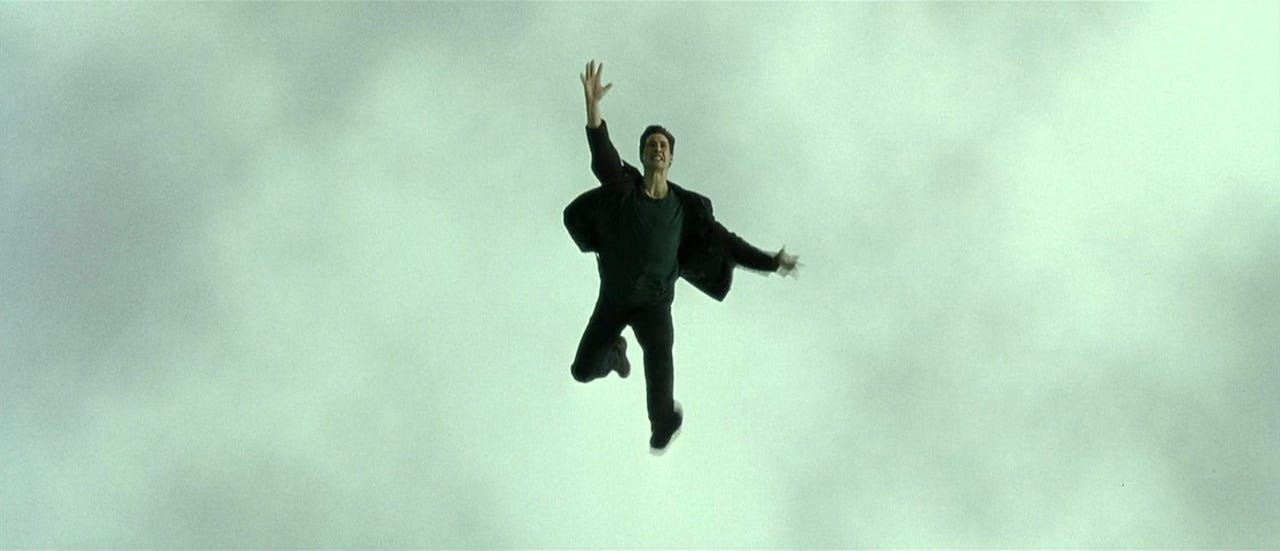
But the prop is doing something the film never comments on.
That copy has been emptied. The pages are cut away. Nobody read it. Nobody could read it. It sits on the shelf performing the function of a book while containing something else entirely. It exists to look like the right object.
Which is precisely what Baudrillard spent the book describing.
He was interested in a particular kind of image. Not one that lies about reality, and not one that distorts it. One that masks the absence of it. A surface convincing enough that you stop asking what’s behind it, because there’s nothing behind it, and the surface is doing all the work by itself.
Neo’s book is that. Your book at page forty is that. The photograph of it on the wooden table is a surface pointing at a person who reads, and the reading is the part that got cut out to make room.
Baudrillard, for what it’s worth, hated the film. He told an interviewer in 2004 that the Wachowskis had misunderstood him, and he turned down their offer to work on the sequels. He may well have been right about the film.
The book on the shelf is still the most accurate thing in it.
So go back to the train.
You’re sitting there and you know all of this, and the knowing changes nothing. The person across from you is still on their phone. You’re still on yours. The jeans you’re wearing are the same jeans, and you bought them for reasons you’d describe as personal.
And I should say the uncomfortable thing about my own position here.
I write essays about thinking clearly at a moment when writing essays about thinking clearly has become a recognisable aesthetic. There’s a specific kind of young man who reads Dostoevsky, quotes the Gita, and publishes long pieces about modern life being hollow. At a glance I am indistinguishable from him. I can’t prove to you that this article isn’t itself the third kind of image. A convincing surface produced by someone who wanted to be the sort of person who notices things.
Noticing doesn’t put you outside it. If anything, the pose of the person who sees through modern life is the most crowded pose currently available, occupied by an enormous number of people who each discovered it independently.
Which is why this can’t end with an instruction to be authentic. Authenticity is a trend. It has a look and a vocabulary. Telling someone in 2026 to be authentic is telling them to want what a particular set of people currently want, and calling the disease a cure.
Girard described the disease. Luke Burgis, a startup founder who spent years afterward turning the theory into something you can actually use, gets closest to a treatment. He separates thin desires from thick desires.
Thin desires are highly mimetic. They arrive from the surface, they’re contagious, and they don’t survive a change in circumstances. Take away the audience and the want evaporates, which is how you know what it was.
Thick desires are rooted in something that holds regardless of who’s watching. They don’t need a witness.
His framing of the choice is honest about the cost. It’s between living an unintentionally mimetic life, or doing the harder work of cultivating thick desires. And the second one means accepting that you will miss out on the shiny things. Not pretending you don’t want them. Missing out on them, and feeling it.
The question that separates the two isn’t is this good for me. It’s traceable and specific.
Where were you standing when you picked this up?
Not the culture. Not the algorithm. A person, an account, one specific evening where you watched somebody hold something and wanted it too.
I’ll go first, since it’s an easy question to ask somebody else.
I started writing publicly a few months ago. If you’d asked me why at the time, I’d have said something reasonable about wanting to think properly, about having things I needed to work out on a page instead of in my head. That was true. It just wasn’t the origin.
The origin was an evening I wasn’t paying much attention to. I was scrolling. A writer I’d never heard of had published something long and unhurried, philosophers in it, no urgency about it at all, and the responses underneath were a particular kind of response. People weren’t saying they agreed. They were saying something closer to thank you.
I sat with that longer than the post deserved.
What I felt wasn’t a thought arriving. I want to be clear about that, because it would be more flattering to say I read it and something in me recognised the work. That isn’t what happened. What happened was smaller, and worse. I wanted to be talked about the way those people were talking about him.
I knew nothing about him. Still don’t. Forty posts and none of his life. No idea how long he’d been at it, what it had cost, what he’d stopped doing in order to have that voice, whether any of it had made him happier.
I took the want and left the price behind.
Some of what came out of that is thick, I think. I do need to write things down to know what I think, and that would be true if nobody read any of it. That part holds.
But some of it is thin and I can still feel it working. The reflex to check numbers. The flatness when something I cared about lands quietly. The pull toward whatever shape of essay is being praised this month. None of that is mine. I picked it up in one evening from a stranger and have been carrying it since without ever agreeing to.
I haven’t put it down. I don’t want to claim I have. But I can see it now, and seeing it turns out to be the only difference actually available.
Sometimes you’ll trace a want back and land somewhere fine. You watched someone you respect do something well and you wanted it too. That isn’t contamination. That’s transmission, and it’s how everything worth having gets passed along. Most of what’s decent in me arrived exactly that way.
Sometimes you’ll trace it back and find nobody there. Just a surface you encountered enough times that repetition became preference. That one’s thin, and it won’t hurt for long to put it down.
And then the thing that changes the frame, which is where I’ll leave it.
You are already a model for someone. Somebody younger. Somebody at work. Somebody who reads what you write, or watches what you buy, or notices what you seem to be chasing. You didn’t apply for this and you can’t resign from it.
Girard’s mechanism doesn’t only run toward you. It runs through you, outward, into people who are watching more closely than you think.
Thiel understood the theory well enough to build on it. Girard understood it well enough to be frightened of it. Both of them were reading the same pages.
Burgis puts it as a way to live. As though you are responsible for what other people want.
Which means the question isn’t only whether your wants are borrowed. They are. That part was never up for negotiation.
The question is what you’re currently transmitting. And whether you’d be comfortable if someone traced their want back and found you standing at the end of it.
~ The Thinking Lab