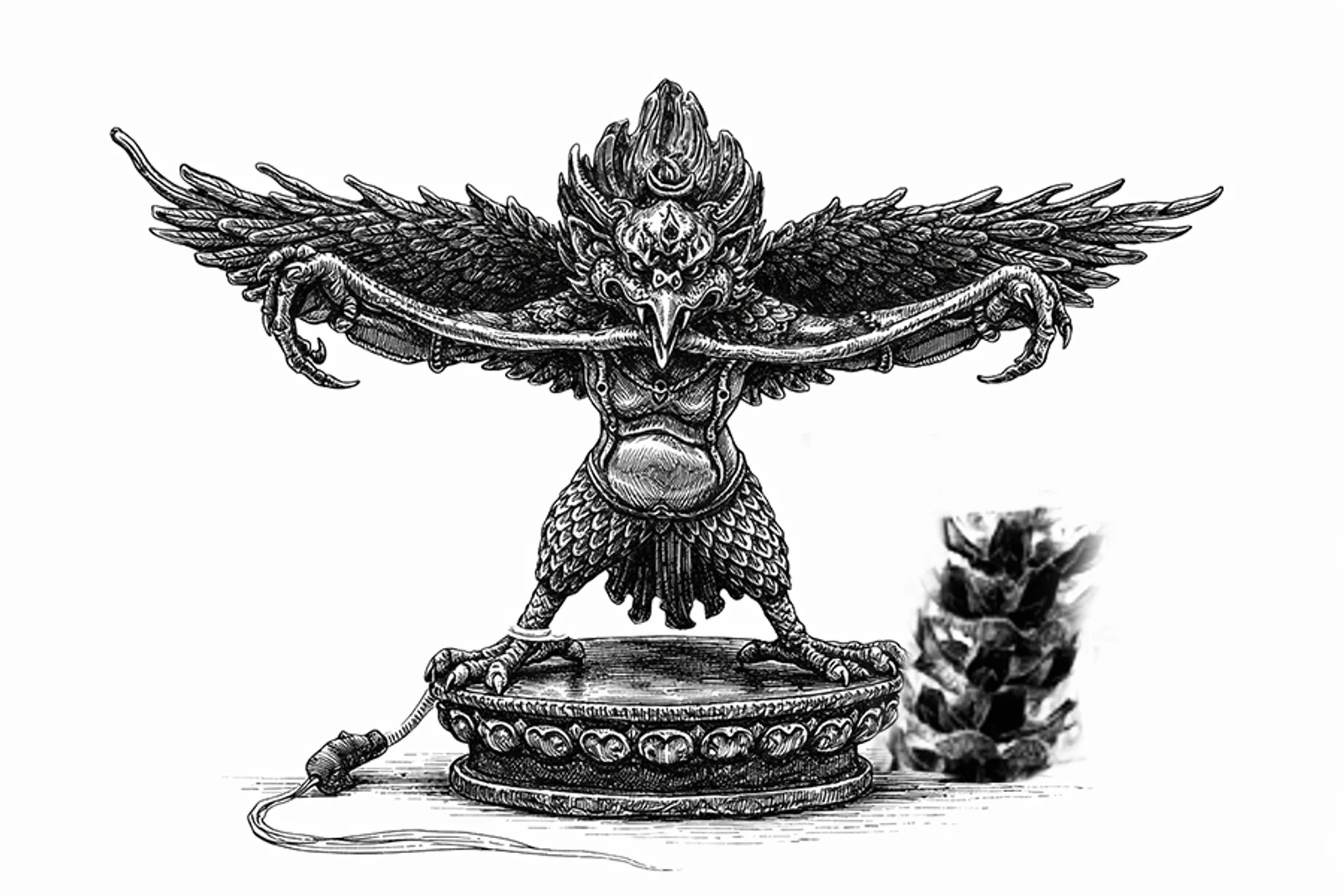
On the Two Deaths, and a Purity That Is Not Waited For but Lived
Companion essay — to the haibun “The Peak Is Already the Turning”.
---
I pointed out that purity is the one constraint that cannot be broken, because it was never assembled.
Purity is not partitioned. Partitioned there is no purity. Purity is not emptiness. Purity carries no form. Purity is an unbreakable constraint. It is unsupported. It has no essence. It is stainless. It is luminous. (Experience demonstrates it is not light.) Purity is the entirety. Purity is always enough. Viewed it is not seen. Inseparable, one is never parted from it. Purity finds only equality.
This is what I mean by an unbreakable constraint. The cushion is not favored. The ritual does not polish it. The koan is not a decoration. There is no view. There is no result. There is only the conduct. The conduct that does not deviate from purity.
The principal conduct within purity is Voluntary. The one requirement that stabilizes the five actions: they are voluntary, or they are nothing. Those listed below operate in the inseparable domain of Purity and Equality.
Respect — honoring what is, without agenda. Demanded, it collapses to domination.
Sincerity — inner and outer aligned, no performance. Required as display, it collapses to pretense.
Safety — refuge that cannot be withdrawn. Imposed, it collapses to oppression — safety demanded is already threat.
Trust — reliance that deepens rather than tests. Compelled, by loyalty oath or test, it collapses to lying.
Honesty — truth without manipulation. Made strategic, it collapses to misdirection.
The instant any action is compelled, grasped, or commodified, it does not fade — it flips to show the unintended consequence: REFUGE lost.
Refuge has no coming or going. It is not sanctuary. It is not shelter nor compassion. Refuge is the purity that demonstrates completely: nothing has been excluded, is not now excluded, and will not be excluded. Refuge is voluntary. Here is the difference and it is not stated lightly: Bodhicitta is noble and a good start but it is the action of an agent acting for the welfare of another. An extension of goodwill in a field of intention and a passport stamped with a visa for good behavior.
These are not a checklist on the way to purity — they are purity in conduct, the daily shape of living inside the unbreakable constraint. Purity stands as never assembled it never breaks. The two deaths, the ordinary and the other-than-ordinary, mark a constraint that although unbreakable harbors a limit.
A wall can be broken only because it was built; purity was never built, so there is no seam in it to start the tear. But there is a second constraint that also cannot be broken, and it is the one everybody knows without being taught: death. You try to break death the only way it seems breakable — by delay — and you mistake the delaying for escaping. It is not escape. The wall has not moved; you have only walked toward it more slowly. Medicine, where I spent a working life, is in the end a delay mechanism. It slows disintegration; it does not stop it. Life itself is a delay mechanism. Death is the return of decay to its ordinary speed.
So now there are two unbreakable constraints standing in the room, death and purity: the two are not equal. Death is conditioned. Purity is the unconditioned.
Death is subsumed in purity
Both are unbreakable, but they do not stand side by side as peers. Death is below purity. Purity subsumes it. This is not a ranking of importance; it is a fact about decay rates and about time. Death is an event — a rearrangement at one magnification, the cloak of mud and feathers dispersing and reorganizing. An event is something that happens, and to happen it requires time. But purity has no time for an event to occur in. It is the unorientable surface, what I describe as the kleinium with no inside and no outside; what cannot be oriented in space cannot be oriented in time, and what has no orientation in time has no decay rate, and so admits no event. Death is something that occurs. Purity is not the kind of thing to which anything can occur.
That is what subsumed means here. Death does not happen to purity; death happens within the field that purity names. The dying is entirely real — at its own magnification it is total — and it changes nothing about the ground, the way a wave’s breaking is total for the wave and nothing at all for the sea. Death is the constraint that we suffer as a limit. The death is not a blemish on purity, because there is no surface on purity for a blemish to mark. Purity is the reality we have never been parted from.
A life and its death must match
If the matter ended there, it would be cold comfort — a clean metaphysical fact with no meaning to an actual life. But there is a second observation: a life and its death have to match. They are made of the same material, so they cannot help but agree. Live a chaotic life and the chaos follows into the dying. Live a graded life of joy and sorrow — and joy and sorrow are always graded, there is always a lower rung someone can push you down to — and the death inherits the gradient: the unfinished reaching, the rung not yet climbed, the level still hoped for.
The Four Immeasurables exposed.
The offering of ordinary Bodhicitta:
May all sentient beings have happiness and its causes,
May all sentient beings be free from suffering and its causes
The offering of other-than-ordinary Refuge:
May all sentient beings never be parted from sorrowless Bliss,
Free from bias, attachments, and fierce emotion.
There are degrees of happiness and suffering. Bliss, by contrast, has no degrees. It is uniform, sorrowless, level. A life that has found the level is not confused by ordinary death: the Goldilocks struggle.
So the question was never will I escape death. You will not. The question is what your death will be consistent with — and that is decided entirely by how one attends purity rather than happiness and sorrow, while you live. Attending to Bodhicitta or Refuge. Here the two things separate, and the separation is not chaos against order. It is more pointed than that. It is a purity kept waiting against a purity already lived.
The first death: a hope for purity, waiting
The ordinary death is the death of a life in which purity was always elsewhere — postponed, conditional, set on the far side of the wall. The Christmas lights, real and magical, handed to the child as a gift with a hook set in it: see how Santa treated you — now be good, be worthy enough for this joy. The congregation that professes the net of inclusion for one day and spends the rest of the year in its plain opposite. The hierarchy, in nearly every religion that keeps one segregated and apart, teaching that you are unworthy, that you must seek grace, that you must be made perfect — wear this, walk like this, do only this — before perfection will consent to receive you. In all of it purity is a promise: hope that it is there, behave so that you might deserve it, and die still reaching for it.
This is the moth’s way. The moth spins a cocoon — an enclosure built in hope and meant to be escaped — and the purity it wants is imagined outside the box it has sealed itself into. It is also the way of the vaporware fortune: a wealth backed by nothing, a perfection of having that recedes one fortune further each time you near it, a promise you can never cash because there was never anything behind it. The ordinary death is bought on exactly that vapor — a purity backed by nothing present, a hope that the next rung, or the rung beyond death itself, will at last hold the weight.
I will not diminish this life. It is the ordinary life, samsara, the life that is actually being lived, and you have real say within it. But its death is ordinary precisely because its purity was always waiting and never lived. You die hoping. The lights were only ever seasonal, and the season ends.
The second death: a purity lived, unbreakable even by death
The other-than-ordinary death is the death of a life in which purity was not waited for but lived — recognized as already the case, and carried into the conduct of the days. You are already perfected. Oṃ svabhāva śuddhāḥ sarvadharmāḥ — pure by nature, already, before any effort is spent. So purity is not a destination past the wall; it is the standing condition of the one who walks toward it. And here the two unbreakable constraints meet in their proper order. Death can break only what was assembled, can rearrange only what was built. Purity was never assembled. So death, arriving in its full totality at its own magnification, finds nothing in the purity to tear. The transition cannot violate the constraint the life never violated. A death whose entire path was purity is unbreakable by death — not because the limitation imposed by dying is avoided, but because the thing that organized the life is not the kind of thing dying can reach.
Nothing mystical is being claimed. There is no magical thinking here about the far side, no prophecy, no private knowledge of what one passes into. The claim is small and exact: you cannot break purity by dying, any more than you could by living, and a life consistent with purity therefore meets a death consistent with purity — which is an other-than-ordinary death. That is the whole of it. It is the butterfly, not the moth. The butterfly never built an enclosure to escape; the chrysalis is its own body. It never denied what it was becoming, even without knowing what that would be, and so it carries no remorse — it does not even possess the word, because it never abandoned anything to regret. Egg, caterpillar, butterfly are levels of one expression that never once left itself. Death, for a lived purity, is a level of that same expression: a rearrangement at one magnification inside a continuity that was never broken.
The earth simply continues to be the earth
The first death needs a judge to keep its logic running — a god who shakes your bed because you offended him, who delivers suffering as a verdict, so that purity must be earned in order to escape the sentence. But suffering arrives as motion without malice. The earth has motion — tectonic, spinning, casting weather — and no intent in any of it; it is not alive and it never thinks itself bad. It simply says, I will go on being the earth, and the earthquakes and buildings fall on the offended and the unoffended alike: on the man sipping his cappuccino who walks away certain a larger god was protecting him, and on the thousand who do not walk away at all. There is no worthiness to establish before an event that has no judge inside it. Remove the judge, and the entire apparatus of deferred, conditional, hoped-for purity loses the reason it existed. What remains is not a purity to deserve but a purity to live.
Home
You do not prepare the other-than-ordinary death with the large wake, the seventeen days lying in the rotunda, the body kept in a glass box forever, the form sealed in a statue forever. Those are arrangements for a hope still waiting.
You prepared. Archimedes found that the crown was not pure gold — by displacement, sitting in the most ordinary tub there is, the truth arriving in plain bathwater and worth running out naked to say aloud.
You prepared. By making every action count in that way now, today: asking in the kitchen, in the garden, on the phone, at work, the one question that keeps you in the luminous space — what am I doing, and does my conduct match my intended result?
By naming it purity we have already made it a little impure, given it a shape and a definition; so hold the word lightly, and remember that you cannot be anything other than the unarisen, sorrowless Bliss, free from bias, attachments and strong emotions.
Two deaths are offered. The ordinary death, at the close of a life that kept purity waiting — a hope backed by nothing, a cocoon built only to be escaped. And the other-than-ordinary death, at the close of a life that lived the purity it could never reach and never had to reach, because it had never left it — a chrysalis, the body’s own, unbreakable even by death.
Home, my home. Make it that way. Hum Phat!
Colophon
The work is personal. The material here is original arising directly from my sitting contemplation. It is protected under Any Note Press. It’s publication here permits no commercial use. All rights are reserved. It is offered for the benefit of one’s practice and nothing else.